Ryan Yerby
Mechanical Engineer
How Pitchers Make the Ball Move: An Overview
In baseball, the pitcher’s role is to throw the ball over home plate into the strike zone. Pitchers have. The ability to manipulate the speed and spin of the baseball to make the ball more difficult to hit by changing movement profile of pitch. As the baseball leaves the pitchers hand, it travels through the air toward the batter. While it travels through the air, aerodynamic forces are exerted on the ball, impacting the movement and profile of the pitch. In this blog post, we will look some of the most common pitches and look to explain how these pitches move through space.
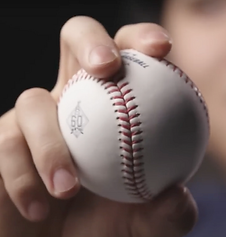
The first pitch we will look at is the four-seam fastball. The four-seam fastball is thrown with spin normal to the vector of ball motion. This maximizes aerodynamic forces on the ball and results in maximum ball movement. In baseball, spin that is normal to ball flight is considered 100% efficient. For a typical pitcher, this spin on a four-seam fastball will appear to be “back spin”. This back spin gives the ball lift and positive vertical break as it travels through the air. This lifting force will fight against gravity while the ball approaches the plate and makes the ball move upward in comparison to a ball traveling at the same velocity with no spin. A four-seam fastball that is spinning faster (higher RPMs) will move more than the same pitch spinning at a lower rate. The four-seam fastball is typically the highest velocity pitch as the pitcher throws it by applying force with the index and middle fingers through the center of mass of the baseball.


Another popular pitch used by many pitchers is the curveball. The curveball is thrown with topspin, or spin in the opposite direction as the four-seam fastball. Like the four-seam fastball, the curveball is thrown with spin normal to the motion vector of the baseball, yet 100% spin efficiency is much more difficult to obtain with a curveball than with a four-seam fastball. This is because of the wrist angle required to spin the ball when throwing the curveball. The curveball moves in an up to down motion. In baseball, this movement profile is called 12 to 6 as the ball would move from the 12 to the 6 on an analog clock. Similar to the four-seam, a curveball with more spin will have more movement than a curveball with less spin. The curveball drops significantly because the spin and the downward force of gravity act in the same direction and add together to move the ball downward. A curveball is thrown by pulling down a seam over the top of the ball. As a result, the curveball is thrown at a slower velocity than the fastball. This slower velocity also makes the ball drop more by increasing the time aerodynamic and gravitational forces are applied to the ball.


The final pitch we will analyze is the slider. There are a few classifications of sliders, in this post we will cover the gyro slider. The gyro slider is thrown with spin that is parallel to the direction of ball flight. This means that the spin of the ball interacts minimally as it travels through the air. The gyro slider travels through the air with side spin, similarly to how a football travels through the air. A slider with perfectly gyro spin has 0% spin efficiency and the spin does not contribute to the movement of the ball. Compared to the fastball, the gyro slider appears to move downward. This is because the spin of the ball does not lift the ball up as with the fastball. The pitch is designed to be thrown on the same plane as the fastball and then violently drop as it approaches the plate. It can be thrown at a velocity in between the velocities of the fastball and curveball because it is thrown by pulling down on a seam located on the side of the ball. By pulling down on the side of the ball, more force can be generated compared to the curveball.

A pitcher who understands how to manipulate the baseball to achieve specific movement profiles can alter hit pitches based on hitter swings and in-game situations. There are many other pitches that leverage a combination of these spins to achieve unique ball movements. Pitchers who are aware of the physics behind ball flight have a distinct advantage over their peers and are often able to add and develop new pitches to their arsenal more quickly.